Markdown is the source of truth
Notes are ordinary .md files. The index, the graph and the version history are derived from them: without Notarium the files are still complete notes, and import and export lose nothing.
Open Source
Your agents, Markdown, and editor — in one container.
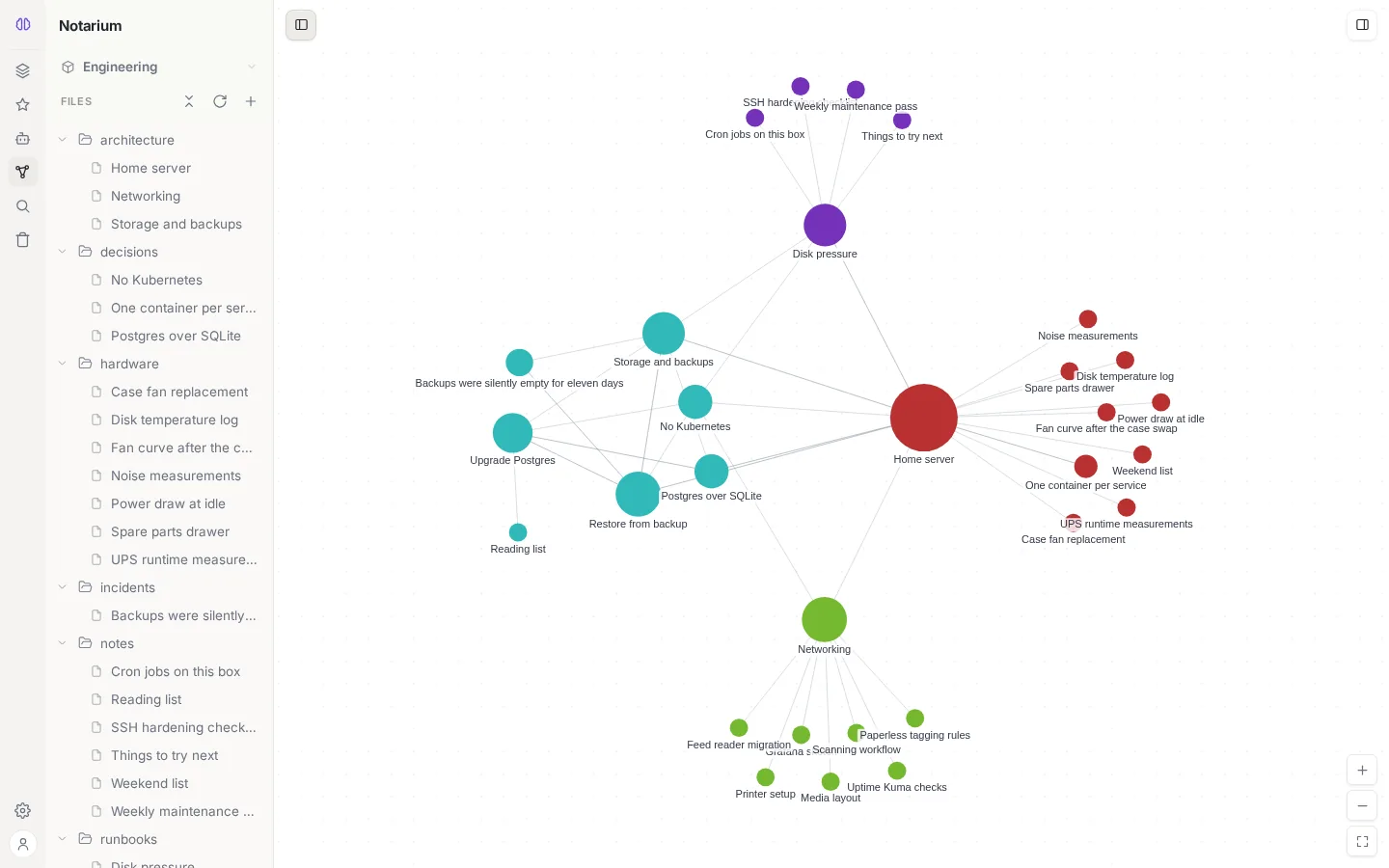
The engine runs in-process: no external database, no queue, no separate search service.
docker run -d --name notarium \
-p 3000:3000 \
-v notarium-data:/data \
docouno/notarium:latestGive it a few seconds, then open http://localhost:3000.
A single /data volume holds all state: your notes, the metadata database and the indexes.
Notes are ordinary .md files. The index, the graph and the version history are derived from them: without Notarium the files are still complete notes, and import and export lose nothing.
A tree that holds tens of thousands of notes, a CodeMirror editor, wiki-links, a knowledge graph. Real daily work in the browser, from any device.
A built-in MCP endpoint: an agent writes into your knowledge base through the same path and the same permissions you do. Spaces and projects scope that work — an agent takes on the project it needs, not the whole base.
One container instead of a multi-service stack. Authentication, spaces and search live inside it; the only thing exposed is a port.
Full-text search always works, semantic search is opt-in, and results merge through RRF. Not a premium feature, not a separate subscription.
Every edit lands in the note's revision log, signed by its author: you can see what a person changed and what an agent did. Any version can be compared with the current one and restored.
A folder of Markdown files gives an agent text. A knowledge base gives it structure — links, a graph, search — so it retrieves the context it needs instead of dumping everything into its window.
Full-text and semantic search across the whole base — what reaches the context window is what matters.
Wiki-links and the graph hand the agent the structure of what it reads: from any note, what it connects to.
Narrow, intent-oriented tools instead of raw CRUD. The gateway is a trust boundary, not a convenience wrapper.
An agent gets there fastest when the route is written into its rules file: a session then opens on the project instead of feeling around for it.
## Notarium- At the start of a session, call start_session(project: "acme/website")- Read the project conventions with get_note("nHk2VqA0es")- Before writing, look for related notes with search("<topic>", project: "acme/website")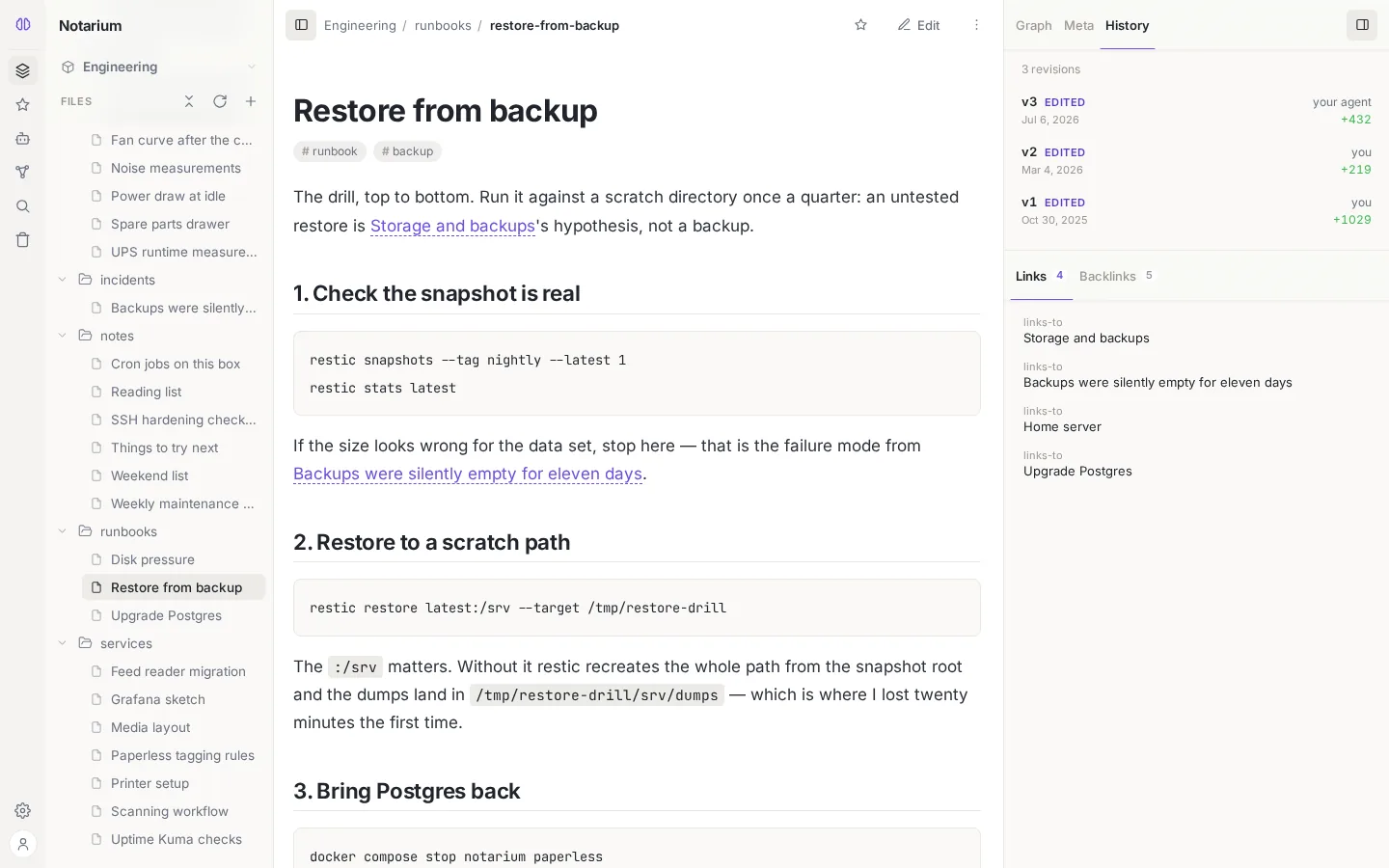
Two different things live here: what Notarium has decided against, and what simply isn't there yet.
Search, semantics, history and agents all need to read your text. Privacy here rests on owning the files and hosting them yourself, not on E2EE. If you need zero-knowledge storage, Notarium is not it.
The unit of data is a note in a file, not a block inside someone's database. That's the price of portability, and we pay it deliberately.
Directions of travel rather than gaps — areas deliberately left for later:
Today it's 0.1.0, an open beta.
AGPL-3.0. Every feature is open and free — including use inside a company as an internal tool. A separate commercial license is only needed by those who monetize Notarium itself as a product.
Read the full license terms →One command brings the base up locally. From there: connect your agent and bring your notes in.